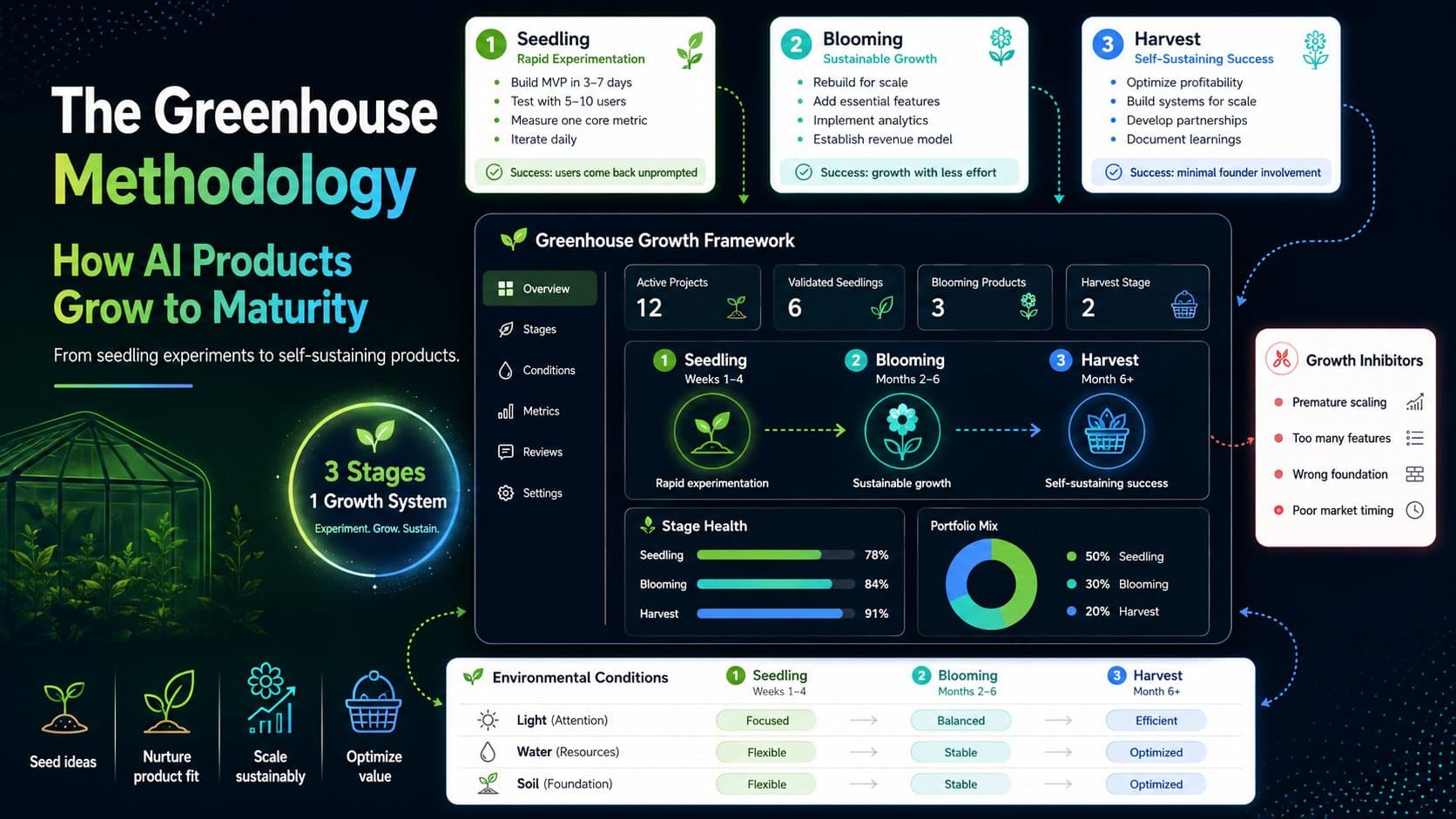
Every successful product follows a similar growth pattern: it starts as a seed of an idea, requires the right conditions to sprout, needs careful tending during development, and eventually becomes self-sustaining. After helping dozens of AI projects reach maturity, we've codified this natural process into what we call the Greenhouse Methodology.
Why "Greenhouse"?
Traditional software development methodologies focus on building—waterfall, agile, lean startup. But building implies you know what you're making. With AI tools and emerging technologies, you're not building as much as you're growing something that's never existed before.
A greenhouse doesn't control growth; it creates optimal conditions for growth to happen naturally.
The Three Growth Stages
Seedling: Rapid Experimentation (Weeks 1-4)
Goal: Prove the core concept works and people want it
Environment: Low pressure, high nutrients (funding/resources), protection from external elements
Activities:
- Build minimal viable prototype (3-7 days)
- Test with 5-10 target users
- Measure one key metric (usually time saved or accuracy)
- Iterate daily based on feedback
Success Criteria: Users come back without being asked
Common Seedling Failures:
- Building too much before testing
- Optimizing for scalability instead of learning
- Falling in love with your first solution
Example - Privy AI Seedling: Week 1: Basic privacy policy input + plain-English summary Week 2: Clearer findings and rationale based on user feedback Week 3: Visual improvements and export options Week 4: A first cohort of users returning without being asked
Blooming: Sustainable Growth (Months 2-6)
Goal: Build a product that can grow without constant intervention
Environment: Balanced nutrients, some exposure to real-world conditions, pruning unnecessary features
Activities:
- Rebuild architecture for scale
- Add essential features based on usage patterns
- Implement proper analytics and monitoring
- Establish revenue model
- Build community/user feedback loops
Success Criteria: Product grows with decreasing effort from you
Common Blooming Failures:
- Adding features faster than users can adopt them
- Scaling too early (or too late)
- Losing focus on the core value proposition
Example - NDI Audio Recorder Blooming: Month 2: Rebuilt with professional audio standards Month 3: Added multi-channel support (most requested feature) Month 4: Implemented licensing system Month 5: 150+ studios using it, word-of-mouth growth Month 6: First competitor appeared (validation!)
Harvest: Self-Sustaining Success (Month 6+)
Goal: Extract maximum value while preparing for the next cycle
Environment: Full exposure to market conditions, minimal intervention, focus on efficiency
Activities:
- Optimize for profitability and user retention
- Build systems and processes for scale
- Develop partnerships and integrations
- Train team/community to maintain growth
- Document learnings for next seedling
Success Criteria: Product grows and generates value with minimal founder involvement
Harvest Optimization:
- Revenue diversification (subscriptions, licenses, services)
- Community-driven development and support
- Strategic partnerships that accelerate growth
- Knowledge extraction for future projects
The Greenhouse Conditions
Just like real plants, projects need specific conditions at each stage:
Environmental Factors
Light (Attention):
- Seedling: Intense, focused attention from founders
- Blooming: Shared attention across team, systematic check-ins
- Harvest: Ambient monitoring, exception-based management
Water (Resources):
- Seedling: Frequent small investments, easy access to funding
- Blooming: Consistent resource allocation, planned investments
- Harvest: Resource efficiency, reinvestment from revenue
Soil (Foundation):
- Seedling: Flexible, quick-to-change foundation
- Blooming: Stable, scalable technical architecture
- Harvest: Optimized, reliable, low-maintenance systems
Common Growth Inhibitors
Premature Scaling: Trying to grow a seedling like it's already blooming Overwatering: Too many features, resources, or attention too early Poor Soil: Wrong technical foundation for the stage Wrong Season: Market timing or competitive environment
Measurement Framework
Each stage requires different metrics:
Seedling Metrics
- Time to first value (how quickly users get benefit)
- Return usage (do people come back?)
- Core metric improvement (does it actually work?)
- Qualitative feedback depth
Blooming Metrics
- User retention curves
- Feature adoption rates
- Revenue per user trends
- Net promoter score
- Technical performance metrics
Harvest Metrics
- Lifetime value vs. acquisition cost
- Monthly recurring revenue growth
- Market share indicators
- Operational efficiency
- Team productivity
When to Transition (Or Not)
Seedling to Blooming
Go when: Users consistently return, core value is proven, growth is limited by product gaps Don't go when: Core concept isn't validated, users need convincing to try it
Blooming to Harvest
Go when: Growth is predictable, operations are stable, market position is established Don't go when: Major competitors are gaining ground, technology is rapidly changing
When to Compost
Not every seedling becomes a harvest. We've learned to compost projects when:
- Market validation fails after honest effort
- Technical challenges exceed expected ROI
- Team passion/capability doesn't match requirements
- Opportunity cost of other projects is too high
Composting isn't failure—it's returning nutrients to the soil for future growth.
Applying the Methodology
For Individual Projects
- Honestly assess what stage you're in (not what you want to be in)
- Align activities and metrics with that stage
- Create appropriate environmental conditions
- Set clear criteria for transitioning to the next stage
- Build in regular "growth reviews" to assess progress
For Organizations
- Portfolio approach: have multiple seedlings, fewer blooming projects, select harvest products
- Resource allocation: most resources go to harvest, moderate to blooming, small bets on seedlings
- Team structure: different people excel at different stages
- Risk management: expect most seedlings to fail, some blooming projects to stall
What We're Learning
The Greenhouse Methodology continues to evolve as we apply it to more projects:
AI tools mature faster than traditional software but also become obsolete quicker Community matters more in the AI space—users become co-developers Technical debt accumulates differently when your core capabilities come from external APIs Market timing is critical in fast-moving technology areas
The Greenhouse Methodology isn't just theory—it's how we've successfully grown projects like Privy AI, NDI Audio Recorder, and Circuit. Want to apply these principles to your project? Let's talk about creating the right conditions for your idea to flourish.